What Co-op Leaders Should Know About Battery Storage
If you’ve sat through a board meeting lately where transmission costs, peak demand charges, or aging substation equipment came up, you’re not alone. These pressures are landing on co-ops across the country at the same time load is growing and member expectations are rising. Battery energy storage isn’t a silver bullet, but for a growing number of rural electric cooperatives, it’s becoming one of the most practical tools available to address all three at once.
This post breaks down what battery storage actually does for a co-op, what real co-ops are doing with it right now, and what board directors and operational leaders should understand before their next conversation about it. The resources linked throughout come from the Co-op Compass, CIN’s knowledge hub for co-op leaders navigating exactly these kinds of decisions.
Why Battery Storage Matters for Grid Reliability
For most of the grid’s history, stability services like frequency regulation and voltage control were provided exclusively by large fossil fuel generators. As those generators retire, something has to fill the gap. According to research on battery storage economics and grid reliability, battery prices have dropped 90 percent since 2010, making storage one of the fastest-declining cost technologies in the energy sector. That price trajectory has opened the door to batteries competing directly with traditional generators to provide grid stability services, and in markets like Texas and California, they’re winning that competition.
In Texas, battery energy storage systems contributed to $750 million in market savings during a January 2024 freeze, while providing the ancillary services that kept the lights on. In California, a single transmission project enabling 2,400 MW of battery storage saved customers $23.2 million in resource adequacy costs in 2022 alone.
The mechanism behind these savings is called value stacking: batteries earning revenue across multiple services simultaneously, including capacity markets, energy arbitrage (storing cheap power and dispatching it during peak demand), and ancillary services. Regions that have designed their markets to allow value stacking are seeing batteries deploy at scale. Regions that haven’t are paying the price literally, with some facing nearly a billion dollars in out-of-market uplift costs in a single quarter.
For co-op leaders, the takeaway isn’t that you need to become an energy market expert. It’s that the economic case for storage is real, it’s already being proven in live markets, and the co-ops that understand it will be better positioned to evaluate proposals, ask the right questions of their G&T, and make decisions that protect their members’ rates.
What Co-ops Are Actually Doing With Storage Right Now
The research and market data matter, but so does seeing what organizations like yours have already done. A look at how co-ops across the country are developing storage capacity highlights several co-ops that have moved from concept to operation.
Snapping Shoals Electric Membership Corporation in Covington, Georgia is piloting a vanadium redox flow battery (VRFB) — a technology that can store electricity for up to six hours, lasts up to 20 years without capacity loss, and can be scaled up without full replacement, unlike lithium-ion systems. CEO Shaun Mock has been direct about why: “The holy grail is long-duration energy storage. Having a piece of equipment like a long-duration battery can help stabilize fluctuations and enable us to provide better service and manage costs.”
In New Mexico, Kit Carson Electric Cooperative is deploying battery systems at two sites configured with grid-forming and black-start capability, specifically to support healthcare operations and critical facilities like fire, rescue, and assisted-living centers during outages. In Arizona, Trico Electric Cooperative developed a 15 MW/30 MWh battery system at a solar facility beginning in 2022. And in North Carolina, the state’s electric cooperatives coordinated 10 batteries hosted at substations across the state to enhance reliability and manage demand at the utility scale.
These aren’t pilot programs run by large investor-owned utilities with deep capital reserves. These are cooperatives operating in rural territories, navigating the same constraints you are, and making storage work.
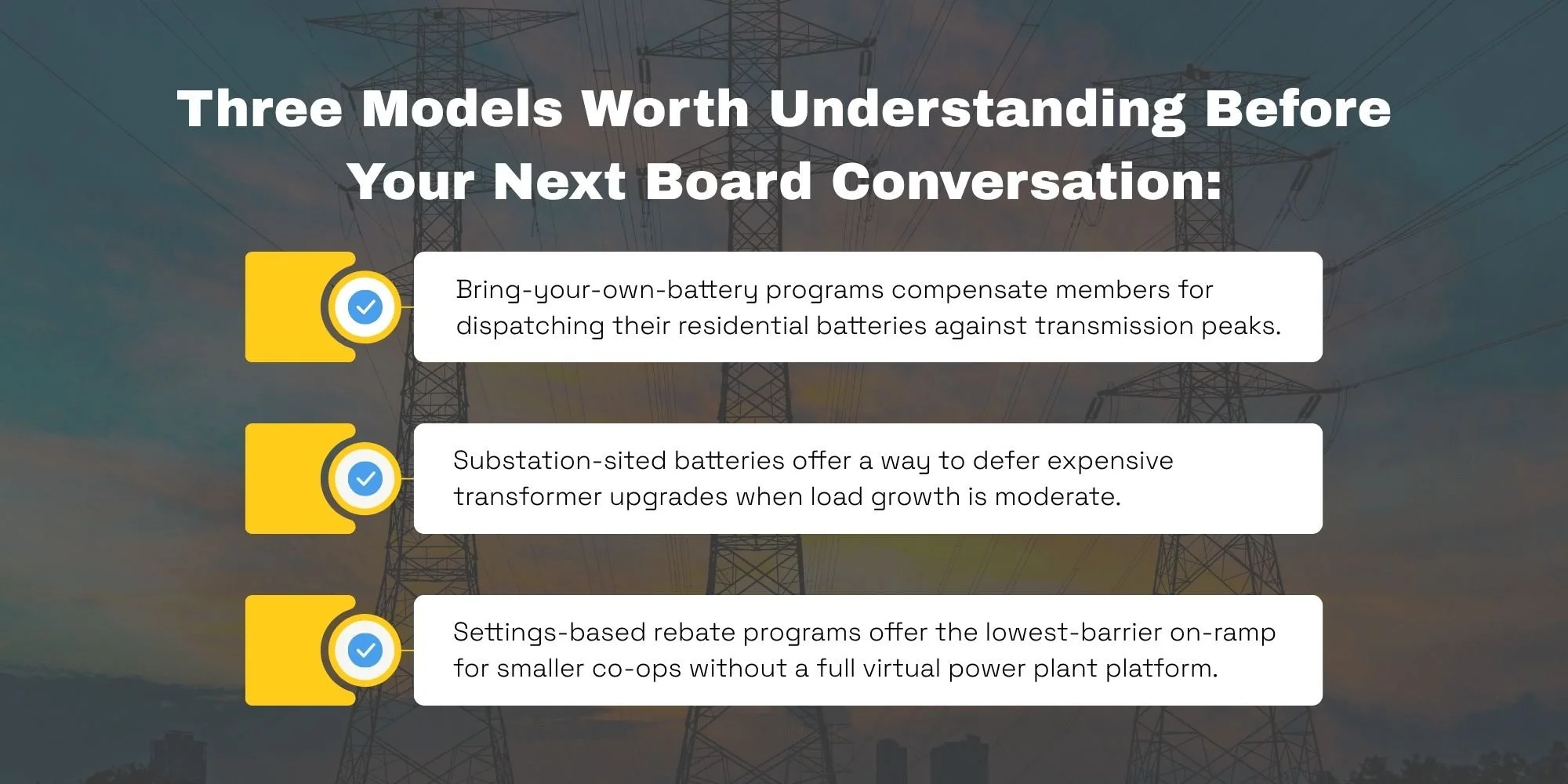
Three Models Worth Understanding Before Your Next Board Conversation
One of the most useful things a board director or operational leader can do right now is get familiar with the range of storage deployment models available, because the right fit depends heavily on your co-op’s size, load profile, and capital position. A deep dive into how co-ops are making battery storage work breaks down three distinct approaches that co-ops are already using:
Bring-your-own-battery programs compensate members for dispatching their residential batteries against transmission peaks. Vermont Electric Cooperative operates this model with more than 200 residential devices, while dispatching against 13 annual transmission peaks. This approach requires accurate peak forecasting but can deliver meaningful transmission cost reductions without significant co-op capital investment.
Substation-sited batteries offer a way to defer expensive transformer upgrades when load growth is moderate. Connexus Energy commissioned a 10 MWh / 2.5 MW battery at a Minnesota substation specifically to avoid upgrading from two 10.5 MVA transformers to two 28 MVA units — a decision that deferred significant capital cost while preserving reliability.
Settings-based rebate programs offer the lowest-barrier on-ramp for smaller co-ops that don’t yet have the scale or vendor partners for a full virtual power plant platform. La Plata Electric Association in Colorado offers a $1,000 to $2,000 rebate per residential battery (roughly 10 percent of system cost), which drove a fourfold year-over-year increase in installations and is achieving 0.8 kW of peak demand reduction per system. The model can evolve into a more sophisticated virtual power plant as adoption grows.
Each model carries different staffing requirements, capital demands, and member engagement needs. But all three have been proven in live co-op environments, which means the risk of trying something new is considerably lower than it was even three years ago.
Storage Doesn’t Work Alone — and Neither Should You
One thing that comes through clearly in the research and the co-op case studies is that battery storage works best as part of a broader set of grid tools, not as a standalone fix. A webinar on how co-ops are managing the surge in renewables makes the case that the biggest affordability gains come when co-ops combine storage with real-time grid awareness, dispatchable distributed energy resources, and planning that builds flexibility in from the start rather than bolting it on after the fact.
Holy Cross Energy in Colorado, a 46,000-member co-op approaching 100 percent renewable supply by 2030, is doing exactly that — combining member battery programs, EV charging management, innovative rate designs, and orchestration software to move toward high-renewable supply while keeping reliability intact. That kind of approach doesn’t happen overnight, and requires co-op leaders who understand the direction the grid is moving and can ask the right questions early enough to shape how their co-op responds.
For board directors, that might mean asking your CEO or GM which storage models are being evaluated and what the peak demand reduction math looks like for your territory. For operational leaders, it might mean attending a webinar on ancillary service markets or taking a closer look at what your G&T is offering in terms of storage incentives or programs.
The Bottom Line for Co-op Leaders
Battery storage is no longer an emerging technology or a topic reserved for large utilities with big R&D budgets. It’s a tool that rural electric cooperatives across the country are deploying right now, in ways that reduce costs, improve reliability, and give members new ways to participate in how their energy system works.
You don’t have to become a battery expert to lead on this. But understanding the landscape, knowing what peer co-ops have done, and being able to evaluate which model might fit your territory — those are exactly the kinds of leadership skills that make a real difference in the boardroom.
Explore more resources on the Co-op Compass, and if you want to go deeper alongside peers who are navigating the same questions, consider applying for the CIN Leadership Cohort or joining us for an upcoming Ideas for Innovation webinar.