How Co-ops Set and Hit Clean Energy Goals
Across the country, rural electric cooperatives are setting ambitious clean energy goals and, increasingly, hitting them. For board directors and operational leaders, the question is no longer whether energy transition is coming; it is how co-ops can lead it on their own terms, without sacrificing the affordability and reliability their member-owners depend on.
The real experience of Holy Cross Energy in Glenwood Springs, Colorado, offers one of the most instructive models in the sector: a journey from 38% to 85% renewable energy that provides a replicable framework for co-op leaders at every stage of the process. Deeper resources are available through Co-op Compass, CIN's knowledge hub for co-op leaders.
Why Co-ops Are Setting Clean Energy Targets
Clean energy goal-setting is no longer an outlier position among rural co-ops. Cooperatives are responding to a convergence of forces: falling costs for wind and solar, state renewable portfolio standards, and growing demand from member-owners for affordable, reliable, and increasingly clean power.
Holy Cross Energy set an initial goal of 70% clean energy in 2017. Within two years, falling costs and growing confidence led the board to raise the target to 100% carbon-free electricity by 2030. Kit Carson Electric Cooperative in Northern New Mexico set a goal of 100% daytime solar by 2022 for its 29,000 members, a goal it exceeded ahead of schedule.
For co-op boards and management alike, these examples illustrate a core truth: goal-setting is not just a values statement. It is a planning tool that aligns board priorities with operational investment, guides long-term contracting decisions, and communicates a forward-looking identity to members and partners.
The Co-op Compass resource on rural co-ops and the clean energy transition provides a broader look at the policy, technology, and member-expectation forces shaping how co-ops approach this work.
Start with a Realistic Line of Sight
One of the most instructive elements of the Holy Cross story is how the co-op sequenced its ambition. It did not set a 100% target in 2017. It set a 70% target it could credibly achieve, built confidence and board alignment through that process, and then raised the bar when the evidence supported it.
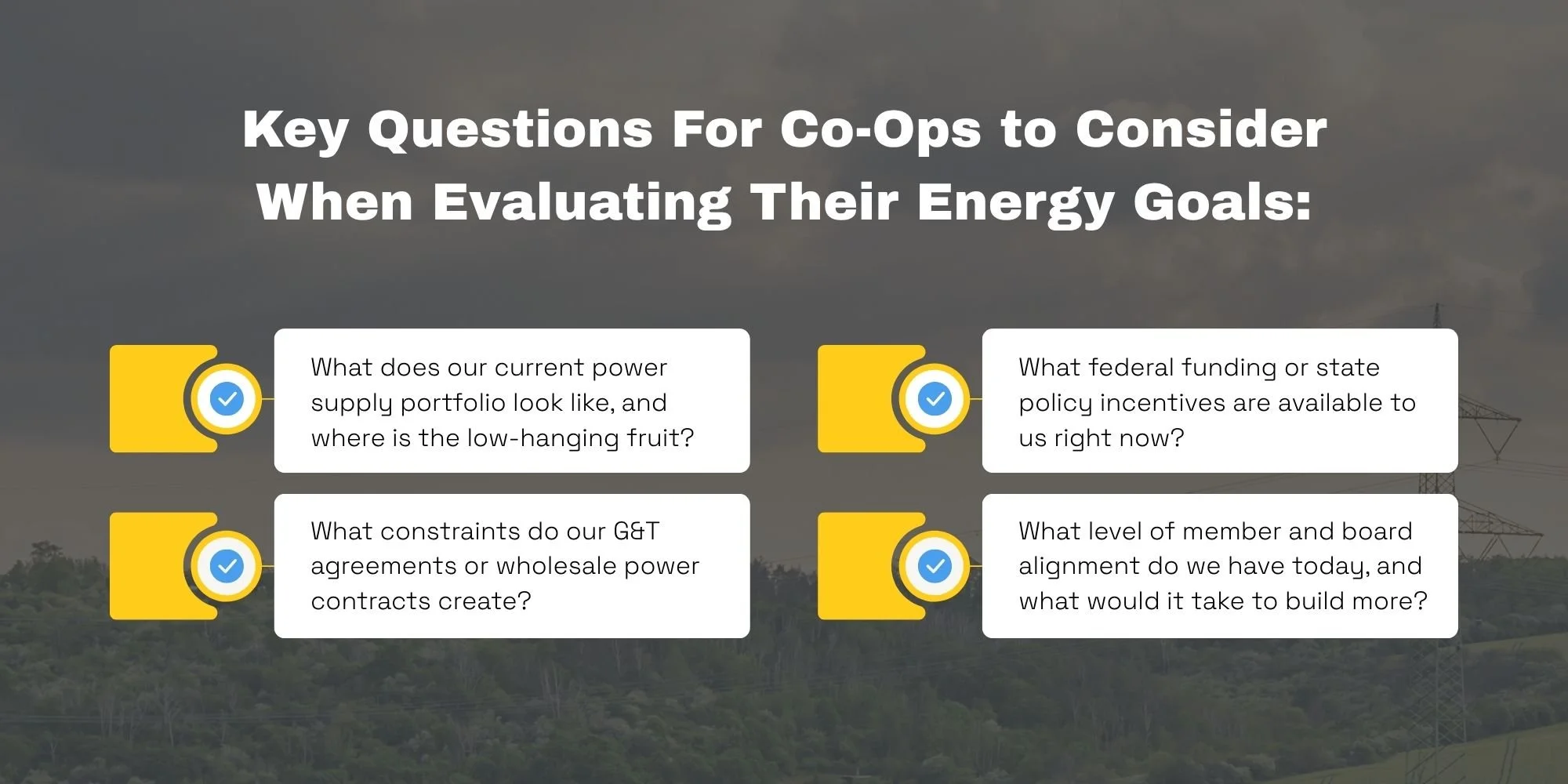
For co-op leaders evaluating whether to set a formal goal, the key questions are:
What does our current power supply portfolio look like, and where is the low-hanging fruit?
What constraints do our G&T agreements or wholesale power contracts create?
What federal funding or state policy incentives are available to us right now?
What level of member and board alignment do we have today, and what would it take to build more?
A goal that stretches the organization without destabilizing it is more powerful than an aspirational target with no operational pathway. The line of sight matters as much as the destination.
Diversify Your Energy Sources Before You Scale
Holy Cross did not achieve 85% renewable energy by doing one thing. It achieved it by layering complementary strategies over more than a decade: a shared transmission agreement that enabled large-scale wind imports from the eastern plains, contracted solar farms within and near its service territory, and a growing portfolio of local solar-plus-storage projects closer to members.
That diversification was intentional. As Holy Cross CEO Bryan Hannegan explained in a recent interview, drawing from multiple generation locations reduces the risk that a single weather event or equipment failure can knock out a large portion of supply. Local projects may cost more per kilowatt-hour, but they add resilience that remote generation cannot provide.
For operational leaders, this has a direct planning implication: a clean energy strategy built around a single contract or technology carries concentration risk. A diversified portfolio, even built incrementally, creates a more durable foundation.
Build the Flexible Grid That Makes Renewables Work
Holy Cross has spent years building what its leadership calls a smart portfolio of resources: demand-side flexibility, member-owned batteries, EV chargers it can manage during peak hours, and dynamic pricing that incentivizes members to shift load.
These programs serve a specific purpose. Renewable energy is intermittent. When the sun is not shining and the wind is not blowing, a co-op needs either storage, flexible demand, or a reliable backup source to maintain reliability. Holy Cross has pursued all three.
Key programs in its portfolio include:
Power+ FLEX: Members receive rebates for installing home batteries that Holy Cross can tap during peak demand periods, adding distributed storage capacity across the grid without building new infrastructure.
EV charger management: Nearly 1,000 home and workplace EV chargers have been distributed to members, with Holy Cross retaining the ability to manage charging rates during high-demand windows.
Dynamic pricing: Members can reduce bills by shifting usage away from peak hours, with programs planned to pay members for using more electricity during periods of oversupply.
For boards evaluating these program types, the value proposition is direct: each of these tools reduces the cost of operating a high-renewable grid by turning members into active participants in balancing supply and demand.
The technical layer underlying these programs is grid orchestration: the combination of real-time grid awareness, dispatchable distributed energy resources, and dynamic planning that allows co-ops to connect new loads and generation faster while preserving reliability and affordability.
As data centers, electrification, and variable renewables accelerate load growth, orchestration is becoming a core operational capability rather than an experimental one. CIN’s Orchestrated Grid webinar walks through how flexible interconnection and virtual power plant platforms work together in practice, with the Holy Cross experience as a grounding example. It is a useful starting point for staff and boards evaluating whether orchestration tools fit their current pain points and how to frame those conversations with G&T providers and vendors.
Keep Rates Competitive Throughout the Transition
The most common hesitation co-op boards express about clean energy investment is the rate impact. Holy Cross addresses this concern directly with its own track record. As of its 2025 milestone, the co-op was delivering electricity at 11 cents per kilowatt-hour, well below both the national average and the Colorado state average, while sourcing 85% of that power from renewable resources.
That outcome was not accidental. It reflected a deliberate strategy of procuring renewable energy early, before supply chain disruptions drove up costs, and leveraging existing transmission infrastructure to access low-cost wind resources. The lesson for co-op leaders is that cost-competitiveness and clean energy are not inherently in tension. Sequencing and contracting strategy both shape the rate equation significantly.
The cooperative model itself offers an advantage here. Member-owned, not-for-profit utilities do not carry the shareholder return obligations of investor-owned utilities. Every dollar saved on power supply flows back to members, not to investors. That structural reality makes the business case for cost-effective clean energy particularly strong in the co-op context.
Engage Your Board and Members as Partners, Not Audiences
The Holy Cross story is also, at its core, a governance story. Board members who understood the technology, tracked the cost trends, and believed in the long-term direction were able to raise the co-op’s ambition when the evidence supported it.
For operational leaders, that board engagement is not just a governance nicety. It is an operational asset. A board that understands distributed energy resources, battery storage, and demand-side flexibility is a board that can approve a battery pilot without months of remedial education. A board that trusts the co-op's direction is a board that can weather short-term rate adjustments without political backlash.
Member engagement follows the same logic. Holy Cross members who participate in the EV charger program or the home battery program are not just customers. They are stakeholders in the grid's reliability and cost structure. That sense of shared ownership is one of the cooperative model's most underutilized assets in the clean energy transition.
CIN's Ideas for Innovation webinar series features co-op leaders sharing firsthand experience with these programs, including how they built board alignment, designed member engagement strategies, and navigated the operational complexity of implementation.
The Path Forward Is Already Being Walked
Holy Cross Energy is not an anomaly. It is a proof point. A rural co-op serving 46,500 member-owners in the mountains of western Colorado built a path to 85% renewable energy while keeping rates well below state and national averages. The strategies it used, from diversified sourcing to demand-side flexibility to strong board governance, are available to co-ops across the country.
The most important resource for any co-op starting or accelerating this work is not a consultant or a vendor. It is another co-op leader who has already done it. That is what CIN exists to connect you to.
Ready to go deeper? Explore clean energy transition resources on Co-op Compass, browse practitioner-led case studies through the Ideas for Innovation webinar series, or connect with the CIN team to learn more about how the network supports co-op leaders navigating this work.
Frequently Asked Questions
Does setting a clean energy goal mean committing to a specific technology?
No. A clean energy goal defines an outcome, not a technology mandate. Holy Cross achieved 85% renewable energy through a combination of wind contracts, solar projects, storage, and demand management. Co-ops can pursue the same outcome through the mix of resources that fits their geography, load profile, and G&T relationship.
What if our G&T agreement limits our ability to add local generation?
This is a real constraint for many distribution co-ops, and it is one of the most common discussion topics in the CIN network. Some co-ops have successfully negotiated flexibility provisions into their agreements, while others have focused on demand-side programs that do not require new supply-side approvals. Connecting with peers who have navigated this specific challenge is one of the most practical ways to identify options.
How do we make the business case to a skeptical board?
Start with outcomes the board already cares about: rate stability, member satisfaction, and grid reliability. Clean energy programs that reduce long-run fuel cost exposure or generate bill savings for members have a straightforward business case that does not require ideological alignment. The Holy Cross record on rates is one of the most compelling data points available: 85% renewable and among the lowest rates in Colorado.
How long does it take to move from goal-setting to measurable progress?
It depends heavily on starting conditions. Holy Cross took several years to move from its first board vote on clean energy goals to meaningful portfolio change, in part because early investments required time to come online. Co-ops beginning today have access to a more developed vendor market, and a larger peer community to learn from. Incremental milestones, tracked publicly, help maintain board and member confidence through the multi-year arc of the work.
Where can I find co-op-specific resources on clean energy planning?
CIN's Co-op Compass is a knowledge hub built specifically for co-op leaders, with resources on battery storage, grid modernization, federal funding, and energy transition strategy. You can also explore past webinars through the Ideas for Innovation series for practitioner-led deep dives from co-ops that have implemented these programs.
