As the year winds down, boards and staff at rural electric co-ops turn to the same question: are our finances where they need to be, and what should next year's budget look like? You don't need to be an accountant to answer those questions. You need to know which numbers matter and what questions to ask.
This post covers the year-end habits that keep a co-op fiscally responsible. For the bigger picture on how co-op finances work, see Understanding Co-op Finance (Co-op Foundations Series, Volume 3) in Co-op Compass.
Why fiscal responsibility looks different at a co-op
A co-op exists to deliver reliable, affordable power to the members who own it. Surplus revenue doesn't go to outside shareholders. It stays in the system, returned to members as capital credits or reinvested in the cooperative. That changes the financial metrics for what defines a "good year" and how to structure the budget for the next year.
Three features shape almost every budget decision:
Long-term debt is the norm. Co-ops typically finance infrastructure through long-term loans from RUS, CFC or CoBank, so debt service is a major driver of rates.
The 85% rule. To stay tax-exempt under 501(c)(12), at least 85% of a co-op's income must come from its own member-owners. Budget assumptions about selling power to non-members or adding outside revenue need to respect that rule.
Capital credits shape what you can return to members. When a co-op runs a positive margin, the surplus is allocated to members as capital credits, but it stays in the co-op as equity until the board votes to retire it.
Start with three documents
Year-end review comes down to three reports, each telling a different part of the story:
Balance sheet. A snapshot of what the co-op owns, owes and holds in equity. Ask: is our equity growing over time, and how does our debt compare to our assets?
Income statement. Revenue and expenses over the period. Ask: are we covering our costs, and what is driving expense increases year over year?
Statement of cash flows. How cash actually moved. A co-op can show a positive margin on paper and still face cash challenges, because margin and cash are not the same. Ask: do we have adequate reserves, and are capital projects pressuring our liquidity?
Know Who Lends to Your Co-op
Most rural electric co-ops fund long-term infrastructure through specialized lenders that understand the cooperative model. Those relationships shape the budget as much as member rates do. Three sources come up most often: the USDA Rural Utilities Service (RUS), the National Rural Utilities Cooperative Finance Corporation (CFC) and CoBank.
RUS is the federal lender that originally financed rural electric infrastructure, and it still makes direct loans and loan guarantees to electric utilities serving rural areas. CFC, incorporated in 1969, is itself a member-owned nonprofit, formed to supplement RUS loan programs. It offers long-term loans of up to 35 years for secured loans, along with emergency lines of credit. CoBank, a member of the Farm Credit System, says more than 75% of electric distribution, transmission and generation cooperatives rely on it for banking.
These relationships are more than financial. Each comes with loan covenants and reporting requirements, and, as CIN's primer notes, covenants can shape a co-op's strategic options as much as the loans fund them. That is why year-end budgeting should start with a clear read of what your lenders require.
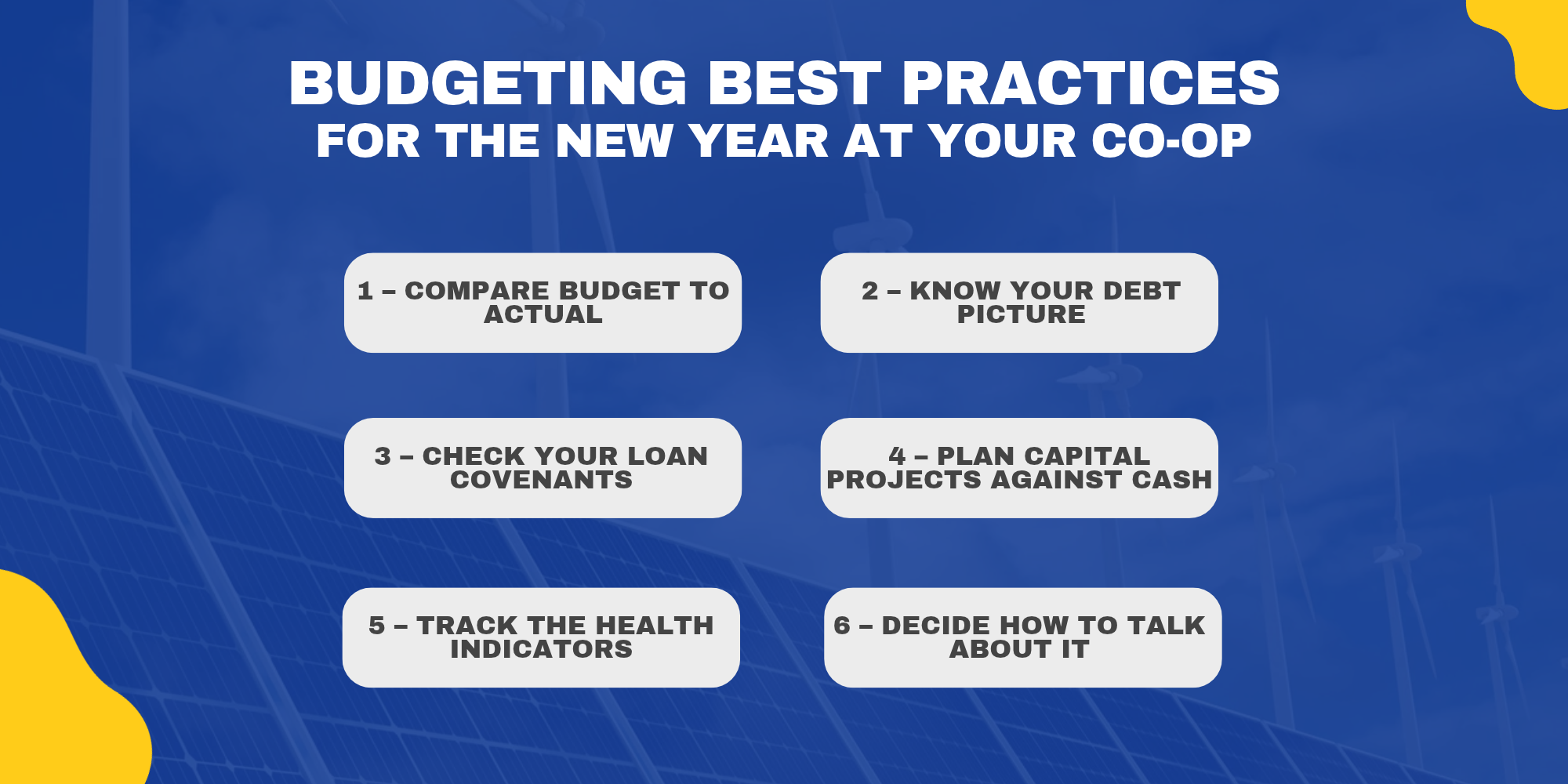
Budgeting best practices for the new year
Compare budget to actual. Before building next year's numbers, look at where this year's plan and results diverged, and why.
Know your debt picture. Debt service coverage, meaning whether operating income can cover loan payments, belongs in the budget conversation, not only the audit.
Check your loan covenants. Covenants are legally binding conditions on borrowing. They may require minimum equity ratios or restrict additional borrowing, so a budget that ignores them can create problems later.
Plan capital projects against cash. Large projects affect liquidity even when the margin looks healthy. Map them to expected cash, not just expected expense.
Track the health indicators. Equity-to-assets ratio, debt service coverage and operating margin trends over time tell you more than a single year does. CFC publishes benchmarks for distribution cooperatives that help put your numbers in context.
Decide how to talk about it. Members own the co-op. Plain-language updates on capital credits and rate drivers build trust before a rate conversation is needed.
Questions boards can ask this month
Is our equity growing, and is our equity-to-assets ratio moving in the right direction?
Are we covering our costs, and what is behind any expense growth?
Do we have enough cash on hand, and where are capital projects squeezing liquidity?
Which loan covenants apply to us, and how close are we to any limits?
Have we reviewed our Form 990? It is public and includes a financial summary, balance sheet and executive compensation.
Go deeper
This post is a starting point. Understanding Co-op Finance (Co-op Foundations Series, Volume 3) in Co-op Compass takes the bigger-picture view: how co-op finances differ from investor-owned utilities, the three core financial documents, the role of RUS, CFC and CoBank, and how capital credits work. It's a 15-minute read written for boards and staff.
Frequently asked questions
What financial reports should a co-op board review?
At a minimum, a monthly income statement, a quarterly balance sheet and an annual audited financial report. Many co-ops also include a cash flow statement and a budget-to-actual comparison.
How do we know if our co-op is financially healthy?
Look at equity-to-assets ratio, debt service coverage and operating margin trends over time. CFC benchmarks for distribution cooperatives help provide context.
Can a co-op lose its tax-exempt status?
Yes, if less than 85% of its income comes from member-owners, which can happen if it sells a significant amount of power to non-members. It's uncommon, but worth knowing.
Why can a co-op have a positive margin and still run short on cash?
Margin and cash measure different things. Capital projects and loan payments can pull cash out even when the income statement looks healthy, which is why the cash flow statement matters.
Want more resources like this for co-op leaders? Sign up for our newsletter.
